Part One: The Analog Advantage
As a long-time teacher of writing and editing, it’s my first duty to inform you that your most important tool for writing is the most analog of all: your backside.
It is, after all, the thing you stick in a chair so you can sit down and simply write! It’s the act that matters; the practice of placing bum in chair and committing words to paper (or a screen, or the back of a shovel). There’s no substitute for consistent effort, no single tool that magically makes you a writer, or an editor.
Except, of course, your bum.
But that’s not to say that the right tools, at the right stages of your process, can’t make a difference. Sometimes a particular tool, or an intentional change of tools, can tip the scales from blank-page horror to creative productivity.
Hence, for the first few entries for this blog, I’m going to talk a little bit about the tools and rituals of writing, their relation to various stages of the writing process, and some of the tools that have proven effective for me.
Why Start Analog?
While the first impulse for many might be to reach for a laptop and Word, I’d like to address analog tools first, since they can be particularly helpful in the earlier stages of writing.
There are three broad advantages I’ve noticed in my own use of analog tools:
- They engage the physical senses. Whether it’s the feel of the inkflow onto paper from a good fountain pen, the earthy scratch and cedar aroma of a quality pencil, or the definitive thwack of the keys of a mechanical typewriter, writing by hand keeps the senses activated. That sensory activation helps me feel, well, more alive, more engaged with my whole self, and, as a result, more able to translate the input from those senses into my writing.
- They can build history and memory. Modern-day digital devices (from laptops to tablets to e-readers) are intentionally designed to have short lives. Most don’t hold on to a laptop for more than a year or two. Analog tools, on the other hand–like a well-made pen or manual typewriter–are designed to last for decades. They can thus build up stories of their own, histories of your own work and creativity that can activate, inform, and enrich what you write every time you use them.
- They activate the more creative, thoughtful, and emotive parts of your brain. This is one of the reasons I find analog tools especially helpful in the earlier stages of writing: note-taking, brainstorming, and initial composition. I find that writing by hand removes a sort of “barrier” I often feel when writing on a computer: The path between mind, words and paper seems shorter, easier to navigate.
My Tools
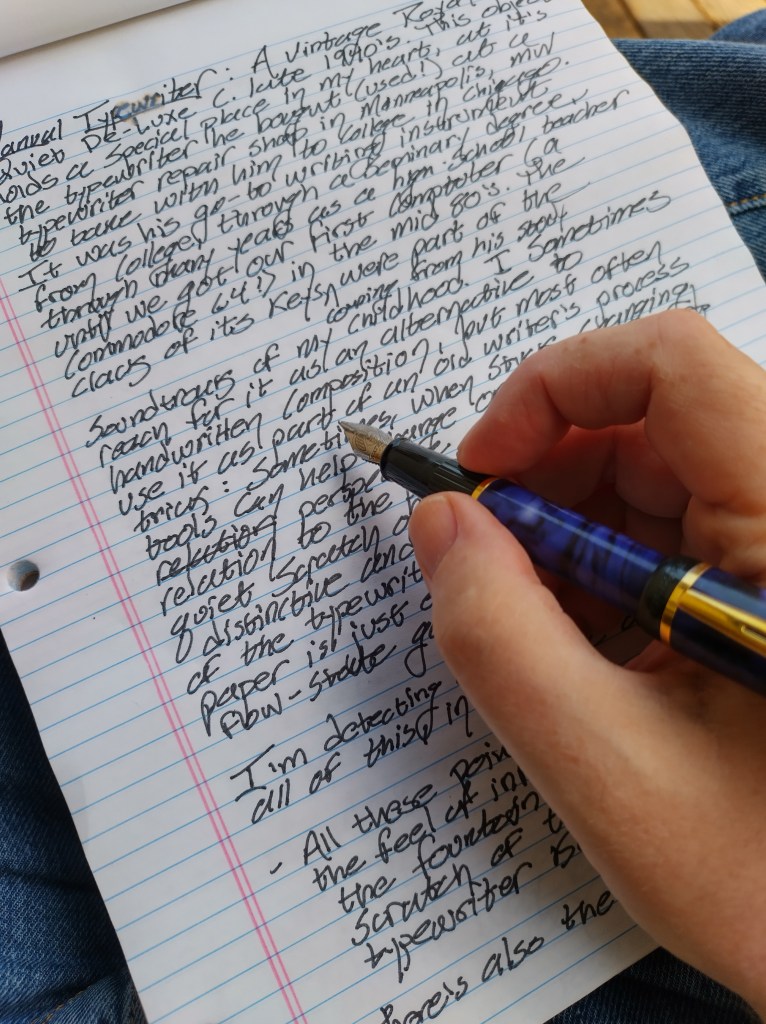
A quality fountain pen. My choice here is a Waterman Phileas. Waterman no longer makes this model, but there’s a close, currently-available equivalent in the Kultur. I discovered fountain pens as an undergraduate, as a way to prevent hand-cramping while taking essay exams (of which, as an English major, I had many!). The smooth flow of ink from a fountain pen requires almost no hand pressure on the page, preventing cramping and leading to a smooth transfer from mind to paper. The pen I use now is one I purchased (I’m amazed to realize) almost 25 years ago. With it, I composed the first drafts of my doctoral dissertation, a book, and many articles since. To pick up that pen isn’t merely to pick up a tool; it’s more like reconnecting with an old friend that’s been there through all of my writing adventures.
Legal pads with thick, high-quality paper. High-quality paper is important for use with a fountain pen, as it makes the writing experience smoother, and ensures that the greater volume of ink a fountain pen lays down won’t spread or smudge, producing clean, readable lines. I like pages that have already been three-hole punched, as I can transfer completed pages into a binder in order to keep them organized as I write, especially for longer documents. I kept the initial draft of my dissertation organized in this way, and those binders full of handwritten text are still, for some reason, dearer to me than the published version.
Well-made pencils. Lower-quality pencils like the ones you used in school tend to be extra-scratchy, dragging across the page, creating inconsistent lines and sore hands. My personal choice for a good pencil is the Palomino Blackwing with its special two-stage sharpener. The sharpener creates an especially long point, which holds for a surprisingly long time. The soft graphite creates a writing experience that’s almost as smooth as a fountain pen, while still maintaining the more earthy scratch of a pencil. They’re also made from incense cedar, so they smell great! I switch between pencil and pen fairly frequently when composing, but tend to favor a pencil when what I’m composing feels very tentative or involves sketching or diagramming along the way. I also tend to reach for a Blackwing when I’m taking handwritten notes.
When I’m copy editing by hand on printed copy (which I often do to get closer to a writer’s words, or to help keep myself from missing things in particularly complex manuscripts), I prefer a mechanical pencil that holds a fine point perpetually. My mechanical pencil is a Pentel Sharp Kerry. Pentel has made this model for many years–I’ve had mine for over a decade, making it one of those “old friend” tools with a lot of history of its own. I’ve edited many a manuscript (and graded many a student paper!) with this thing. Its all-metal body makes it a durable writing companion and gives it–unlike many plastic pencils–a satisfying weight in the hand.
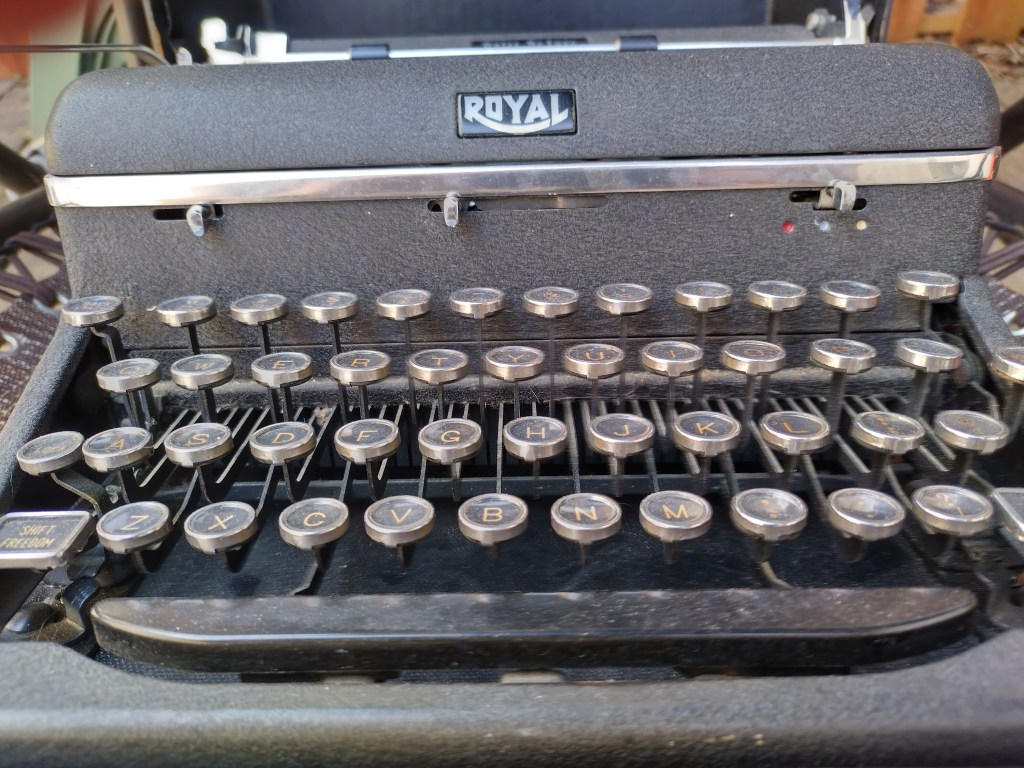
A manual typewriter. One of the oldest writing “productivity hacks” in the book, when one is stuck, is simply to change venues or tools. Somehow, doing so changes one’s relation to the words, and as such it can often be enough to get the words coming again when they’ve been stubborn. There’s also something about the very different feel of a manual typewriter–that distinctive thwack as the key makes an impression on a page. They can take a little getting used to, as punching the keys involves deliberate, strong strikes, but once you get going that constant rat-tat of a manual can be a satisfying sensory experience in itself. For me, it’s enough to get into a new, different flow state when I’m stuck. My personal typewriter is a Royal Quiet De-Luxe, dating to the late 1940’s or early 1950’s. Its history is especially meaningful to me, as it’s the typewriter that my dad bought–used–at a typewriter repair shop in Minneapolis, MN in order to take to college in the 50’s. It was his go-to writing instrument through college, a seminary degree, and a career as a high school history teacher (until we got our first computer in the mid-80’s), and its characteristic sound isn’t merely satisfying–it was part of the soundtrack of my childhood. It doesn’t hurt my own writing process that those warm memories surface whenever I reach for it. Most recently, I’ve been using it as a key tool in a translation project involving a long Middle English poem.
Your Turn
I’d love to hear from others about your go-tool analog tools and the memories and experiences they conjure. Please leave them in the comments!
 Bruce Editing Services