
Here’s a question:
What, as editors, do we do when faced with two technically “correct” choices in a manuscript? What swings the decision in favor of one option or the other?
I ran into an interesting conundrum this past week that raised this question for me, and sent me down a bit of a rabbit hole of research. Both the research and the question it raised seemed worth a post, and I’d be genuinely interested in learning how other editors think about these kinds of situations.
A Wee Conundrum
The problem concerned a single verb, in a sentence that contained the following, in which the writer talked about experiencing:
…the hunger awoken by a taste of the Spirit’s power…
The sticky bit, as many of you have already noticed, is the past participle, “awoken.” In my original edits, I went with my knee-jerk reaction, which was to leave that word choice as-is. Generally, when I’m proofreading I tend to favor the writer’s words unless there’s an actual error, and since “awoken” is grammatically correct there, I left it alone. Another editor working on the same text, however, changed it to a different past participle, “awakened,” as though “awoken” was a grammatical error.
Of course, that difference raised the question in my mind: is one of those options “more correct” in a modern English text? If so, which one?
Turns out that that question is a more pesky little bugger than one might, at first, imagine.
The History of “Awakened” and “Awoken”
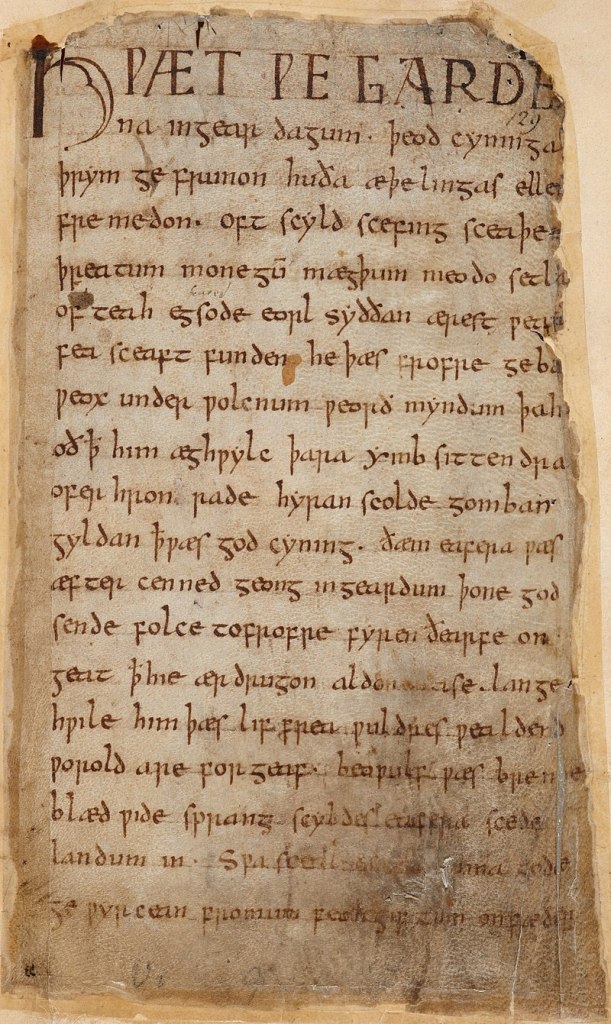
Thinking through the issue, I was able to draw on my experience as a long-time student of the Old English language and reader of OE literature. Part of the problem is that both words (“awoken” and “awakened”) are holdovers from Old English, in which there are also two verbs with the general meaning of “to wake up from sleep:” awacan and awacian.
Now, one important thing to note is that Old English itself has a long history, in which the language changed and evolved over hundreds of years, as all languages do. One effect of that evolution is that there are two general “classes” of verbs in Old English, generally referred to as “strong” and “weak.” The major difference between the two is how they signal changes in tense. “Strong” verbs typically signal the past tense through an internal vowel change, such as from an “a” sound to an “o” sound. “Weak” verbs generally indicate that same shift with the addition of a consonant, either a “d” or a “t.” Thus “weak” verbs tend to become (and look more like) what we call “regular” verbs in modern English.
So, the first of the two OE verbs that broadly mean “to wake up from sleep” is awacan, which, in OE linguistics-speak, is a class VI strong verb. So, the first-person present tense of awacan is awace, the first-person past changes the first vowel to an -o to form awoc, and changes the vowel again to an ash (æ) to form the past participle awæcen. The modern English descendant of this word is awake, and it preserves the Old English vowel change to form the past tense and the past participle, so the first-person present tense is “I awake,” the first-person past tense is “I awoke” and the past participle is “awoken.”
The second OE verb is awacian, an OE “weak” verb. The first-person present tense is awace, and the first-person past tense gets signaled by an added -d: awacede. The past participle form adds the prefix ge- and and ending -d to form gewaced. The modern English descendant in this case is the verb awaken, and, as does its ancestor, it follows the more usual modern English “regular” verb pattern, so the first-person present tense form is awaken, the first-person past tense is awakened, and the past participle is awakened.
So, here we have a situation where modern English, though it doesn’t really need two different verbs with a single meaning, has them anyway because we’ve adopted them, like many other modern English words, from Old English. Not surprisingly, the different ways we conjugate the two modern English verbs derive from their Old English ancestors. The reasons for both the existence of the two words and the grammatical differences between the two are entirely historical.
Does History Help the Editor?
Unfortunately, this means that there does not appear to be any grammatical basis for deciding that one of these modern English words is more “correct” than the other (assuming that either word is used in the grammatically correct way). So, in the sentence in question, where the writer expresses a “hunger awoken by a taste of the Spirit’s power,” I don’t see a grammatical reason to favor “awakened” over “awoken,” as both are grammatically correct. The current definitions in Merriam-Webster don’t provide any help, since it gives the same meaning for both: simply waking up from a state of sleep.
But could there be some help in the words’ ancestors? According to Bosworth and Toller (one of the major Old English dictionaries), awacian (from which we get awaken, awakened) seems only to carry the meaning of “to wake up from a state of sleep.” However, for awacan there are a few other potential meanings connected to historical uses of the word, which include “to be born” and “to wake into being.” A historical example given for the latter meaning is the sentence “Twá þeóda awócon” or “Two nations arose.” So at least at a glance, it appears, at least, that awacan might have a more expansive range of meanings–meanings that include more figurative ideas of what it means to awaken–the idea of something coming into being or arising into a person’s consciousness.
One thing I know about words is that they have a tendency to carry–sometimes only subconsciously–traces of the places they have been. Different words, even those with the same meanings, can evoke different connotations that derive from their histories. Such meanings can register with readers even when they’re not consciously aware of those histories. If you’ve ever had the feeling that one synonym just sounds more “right” in a given situation than another without being able to put your finger on why that’s the case, you’ve probably experienced this phenomenon. That feeling isn’t just coming from some inexplicable place in your gut. You’re likely reacting to the history behind words you’ve been using, and the ways and circumstances in which you’ve used them and heard others use them, throughout your life.
So perhaps this information does, in fact, help with my editorial choice. Surely in that sentence about a “hunger awoken by a taste of the Spirit’s power,” the writer is clearly not talking about a literal awakening from a state of sleep, but rather about the figurative sense of an idea or desire “awakening” in his consciousness. On that basis, the part participle awoken may well be the better choice here, as there is evidence that it has historically carried more figurative meanings.
What Say You?
All that said, I am very interested to hear from other editors: how do you think about situations like this? When there is more than one grammatically correct option, how do you decide which alternative is favorable? What, to you, are the most important considerations? Feel free to post a comment below with your thoughts and ideas.
 Bruce Editing Services
The current slang term “woke” clearly fits the figurative/literal connotation pattern. Nobody would use “waked” to describe someone’s awareness of nuances of social inequalities.
LikeLike
Very good point. Although there are certainly modern instances of forms of “awaken” where the meaning is more figurative–cf Kate Chopin’s novel *The Awakening*. Present particple in that case, I know, but same overall principle.
LikeLike