
I’ve long had an interest in medieval Scottish literature and culture. For a number of years, before I hung out my shingle as an editor, a big part of my job was to be a scholar of the same. For that reason, anniversaries of landmark events in Scottish history tend to catch my attention, like today’s: August 23, 2024 is the 719th anniversary of the execution, at English hands, of the Scottish knight Sir William Wallace. Wallace is known, these days, primarily as the central character in the 1995 Mel Gibson film Braveheart. Much of the plot of that movie is derived from a fascinating long Scots poem, written by a poet generally known as “Blind Hary” around 1477, entitled The Actes and Deidis of the Illustre and Vallyeant Campioun Schir William Wallace.
Even though the film takes a number of its plot points from the poem, I’ve always been struck by the stark difference between the way the poem, as opposed to the movie, portrays that historic execution. The movie’s portrayal is much more similar to English chronicle accounts, focusing, as it does, on the gruesome physical torture and mutilation of Wallace’s execution. The method of execution was a particularly macabre one, as Wallace was drawn (dragged through the streets, tied to a hurdle), hung until nearly dead, revived, and then disemboweled alive before being cut into several large pieces which were then hung up in various strategic locations to advertise his death. That particular form of execution was designed as an especially nasty brand of political theater reserved only for convicted traitors (the English saw Wallace, who fought for Scottish independence from England during a time when the English had essentially taken over, as a traitor to English rule). The message was basically, “this is what the state can do to the bodies of those who defy its sovereignty.” If you’ve ever seen the Braveheart movie, its portrayal is a pretty graphic (and, really, pretty toned-down) representation of that mode of execution.
Blind Hary, on the other hand, treats the execution much differently. Here’s Hary’s account of the incident, first in the original Scots, followed by my own (admittedly very rough) modern English translation:
A psalter buk Wallace had on him ever,
Fra his childeid fra it wald nocht desever.
Better he trowit in viagis for to speid,
Bot than he was dispolyeid of his weid.
This grace he ast at Lord Clyffurd that knycht,
To lat him haiff his Psalter buk in sycht.
He gert a preyst it oppyn befor him hauld
Quhill thai till him had done all at thai wauld.
Stedfast he red for ocht thai did him thar.
Feyll Sotheroun said at Wallace feld na sayr.
Gud devocioun so was his begynnyng
Conteynd tharwith, and fair was his endyng,
Quhill spech and spreyt at anys all can fayr
To lestand blys, we trow forevermayr.
Wallace had a psalter-book on him that he’d carried and would never part with ever since his childhood. But now he was stripped of his clothing. He asked this grace of the knight Lord Clifford: to allow him to have his psalter book in sight. He had a priest hold it open before him until they [the English executioners] had done everything they wished to him. He steadfastly read, no matter what they did to him there. Many English said that Wallace felt no pain. Thus the good devotion of his beginning was carried through to his ending. Until speech and spirit can fare, all at once, to lasting bliss, we trust forevermore.
What interests me about this description is that Hary basically skips over all the gruesome physical details of the torture and instead shows Wallace’s focus, at the end, to be in an entirely spiritual place. Hary takes the opportunity to remind us that Wallace, ever since he was a child, had always carried a psalter (a volume containing the Book of Psalms from the Old Testament) with him, hearkening all the way back to his spiritual beginnings, before his nationalist quest for an independent Scotland (the content of most of the poem!) ever began. Then Hary shows Wallace being stripped naked for the execution, at which point Wallace, instead of expressing any kind of concern for that political mission, disregards it, and just wants to focus on that childhood psalter. His focus thereon is so intense that, according to Hary, several of the English witnesses of the execution said he felt no pain! (That point, by the way, creates a reference to the then-popular genre of narratives of Christian martyrdoms, where the martyr for the faith is often said to have felt no pain.)
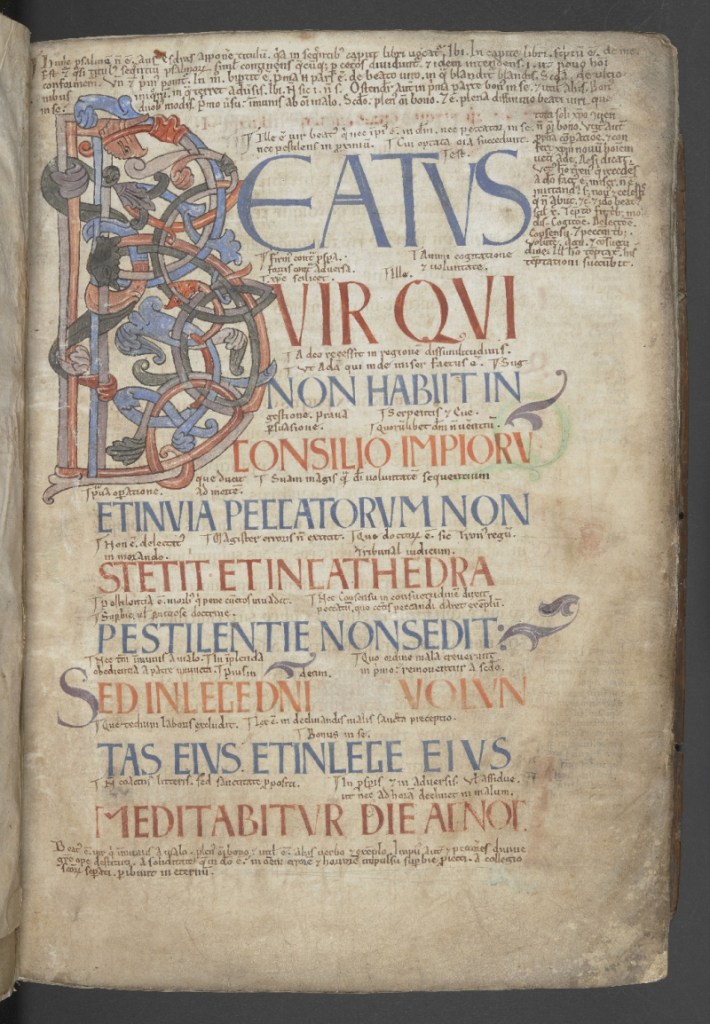
It’s worth dwelling a bit on exactly where Wallace’s focus goes, here. The most common image a medieval reader would likely associate with a psalter would be that of a psalter’s initial page, often called the “beatus page,” after the first sentence, in Latin, of Psalm 1: Beatus vir qui non abiit in consilio impiorum, et in via peccatorum non stetit, et in cathedra pestilentiae non sedit; sed in lege Domini voluntas ejus, et in lege ejus meditabitur die ac nocte. (“Blessed is the man who does not abide in the counsel of the impious, and does not stand in the path of sinners, and does not sit in the seat of scoffers; but whose delight is in the law of the Lord, and who meditates on that law day and night.”) The beatus pages of psalters were often given very special treatment and often intricately decorated, meant to be, in themselves, focal points for spiritual meditation. Hary goes well out of his way, here, to show readers that Wallace’s mind is fixed on the idea of setting aside worldly conflicts and meditating on the divine. A far cry from Mel Gibson crying out about his political “Freeeeeeedom!” at the end of Braveheart.
It’s as though, where the movie wants to be all about Wallace’s nationalism (in many ways equating it to a more American brand of nationalism), and makes its narrative of the execution all about Wallace’s political cause, Hary goes an entirely different direction, a very spiritual direction that questions that nationalist cause. This seems, to me, to pick up on other hints late in Hary’s poem, where Wallace seems to begin to see the reality created by all the violence he’s wrought in the name of nation as increasingly futile and even unreal. Hary says of him at one point that “he seis the warld all full of fantasye.” Everything goes dark and surreal for him, until, at the very end, stripped of all other constructs, he rediscovers the divine.
 Bruce Editing Services